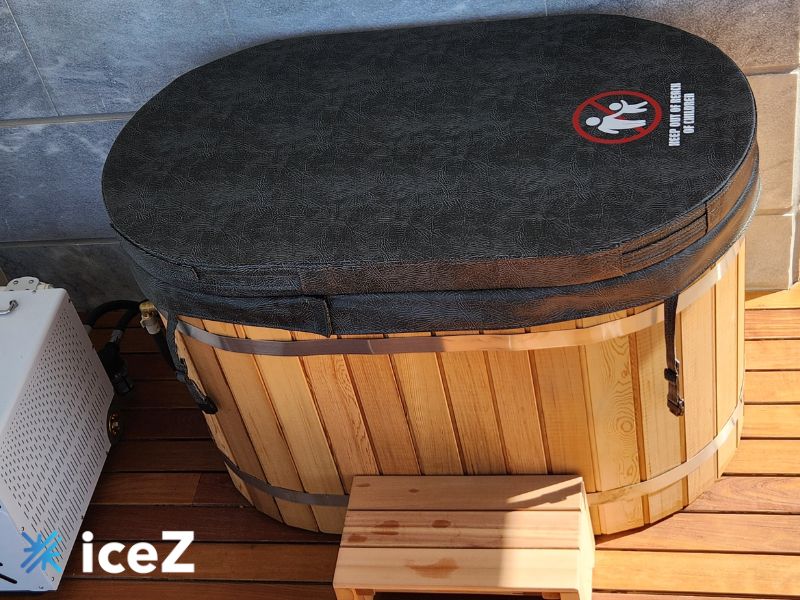
A home ice bath has become a global wellness trend in recent years — not only among professional athletes, but also among people seeking to improve their physical and mental health. One of the most common and important questions that comes up repeatedly is: how long should you actually stay in an ice bath?
Is there a point where the exposure becomes harmful? And what are the actual benefits of cold immersion?
In this article, we’ll dive into the world of ice baths, explore the recommended duration for immersion, and explain how to get the most out of this unique experience.
It’s not a challenge — it’s an experience of resilience.
Often, the conversation around ice bath immersion turns into a competition:
“How long did you manage to last?” or “Next time, I’ll try to stay even longer!”
But the truth is that an ice bath is not a test of endurance — it is an experience of coping and regulating the body under controlled stress. Different people report different sensations, varied insights, and unique benefits from immersing in ice-cold water. 
To understand the appropriate duration for immersion, it is first important to know what happens to our body upon contact with cold water.
What happens to the body during cold immersion?
When we enter cold water, the body undergoes a series of physiological responses:
At this stage, the most important processes begin to occur — those that lead to physiological and mental improvement.
So… how long should you stay in an ice bath?
The ideal duration:
The goal of a home ice bath is to subject the body to controlled stress and remain within the hormetic zone — that is, a measured exposure that leads to improved bodily function.
✅ It is recommended to stay in the cold water for 2 to 3 minutes.
⛔ It is not recommended to immerse for more than 5 minutes.
Gradual start:
If you are new to cold immersion, start with a short duration — 30 seconds to 1 minute — and gradually extend the time as your body adapts.
Is there a “right” duration for everyone?
There is no single correct answer for everyone. The ideal duration depends on several factors:
- Personal tolerance: every body reacts differently to cold.
- Experience level: beginners need to adapt gradually.
- Health condition: people with certain medical conditions (such as heart problems) should consult a doctor before cold immersion.
Always listen to your body — if you experience uncontrollable shivering, sharp pain, or a feeling of numbness, get out of the water immediately.
Consistency is key
Many people ask: “Which is better — a long immersion once a week or shorter immersions on a regular basis?”
The answer is clear: it is better to maintain regular short immersions.
Studies have shown that the health benefits of cold immersion — such as boosting the immune system, improving mental resilience, and aiding muscle recovery — depend on consistency.
It is better to immerse for two minutes five times a week than five minutes twice a week.
The goal is not to break records but to establish a healthy and beneficial habit.
5 tips to improve endurance in an ice bath
If you want to extend your time in the ice water and safely improve your endurance gradually — here are five tips to help you get the most out of the experience:
Remember: the secret to improving endurance is not in the time spent in the water, but in the quality of practice and consistency. With persistence and the right approach, the body and mind will learn to get the most out of every immersion!

Call Us
054-754-04-94
Write to Us
info@icez.life